
Strength Is Built, Not Found: Why Compound Movements, Heavy Lifting, and Periodization Should Be the Foundation of Every Training Program

Every successful athlete, powerlifter, firefighter, military operator, CrossFit competitor, and physically resilient individual shares one thing in common—they all build their training around compound movements. While social media often highlights isolated arm exercises, endless abdominal workouts, and flashy machines, decades of exercise science continue to point toward one undeniable truth: the strongest, healthiest, and most athletic bodies are developed by mastering fundamental movement patterns and following a structured strength progression.
Unfortunately, many people enter a gym without a plan. They perform random exercises, repeat the same workouts every week, and rarely challenge themselves with heavier loads. Although consistency alone will produce some improvements, eventually progress slows because the body adapts remarkably well to repeated stress. This is why experienced strength coaches rely on periodization, a scientific method of organizing training that strategically changes intensity, volume, repetition ranges, and exercise selection over time. Instead of guessing what to do each workout, periodization ensures every phase has a purpose, allowing athletes and everyday gym members alike to become stronger while reducing the risk of burnout and injury.
At Kingdom FIT, this philosophy is exactly why our FORGED program is built around strength cycles rather than random workouts. Members aren't simply exercising—they're progressing. One phase develops muscular endurance, another increases hypertrophy, another emphasizes maximal strength, and another improves explosive power. Every phase prepares the body for the next, creating sustainable long-term results instead of temporary fitness gains.
Your Body Was Designed for Movement
The human body was never designed to isolate muscles one at a time. Every movement you perform throughout the day—whether picking up a child, climbing stairs, carrying groceries, standing from a chair, or loading luggage into a vehicle—requires dozens of muscles working together. Your nervous system doesn't think in terms of individual muscles; it thinks in movement patterns.
This is why compound exercises are so effective.
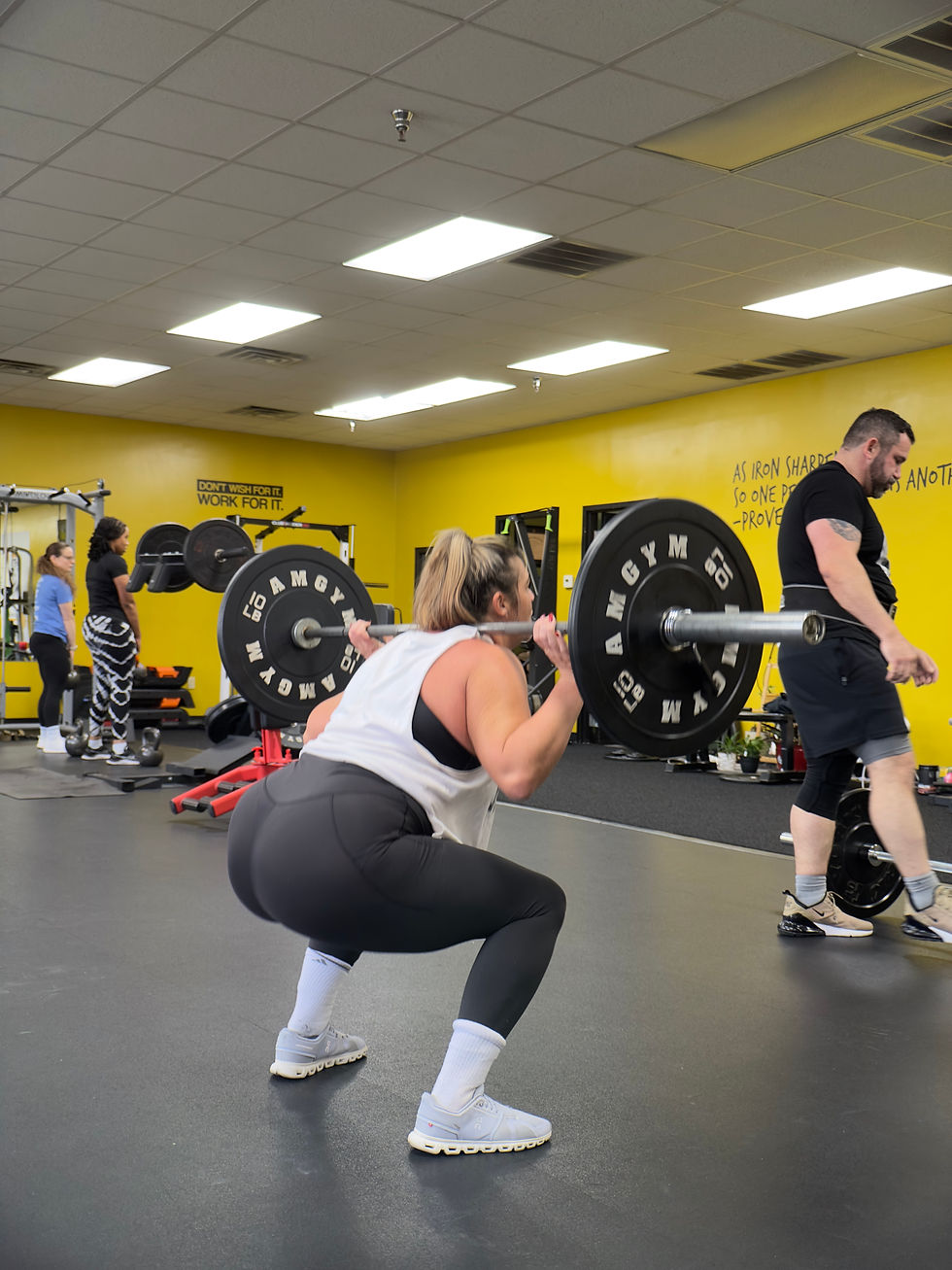
Compound movements require multiple joints and muscle groups to work simultaneously. A squat isn't simply a leg exercise. It demands coordination between the ankles, knees, hips, core, spinal stabilizers, glutes, hamstrings, quadriceps, calves, and upper back. Likewise, a deadlift develops nearly every muscle on the posterior chain while teaching the body how to generate force safely from the ground.
Research published by the American College of Sports Medicine (ACSM) consistently recommends prioritizing multi-joint exercises because they improve overall strength, coordination, functional performance, and energy expenditure more effectively than single-joint exercises alone (ACSM Position Stand, 2021).
Rather than simply making individual muscles stronger, compound lifts teach the entire body to function as one coordinated system.
Examples of Essential Compound Movements
Some of the most beneficial exercises include:
Barbell Squat
Deadlift
Bench Press
Overhead Press
Pull-Ups
Bent-Over Rows
Walking Lunges
Romanian Deadlifts
Farmer Carries
Step-Ups
Olympic Lifts (Clean, Snatch, Push Press)
These movements recruit the greatest amount of muscle tissue, stimulate the nervous system, and provide the highest return on your training investment.
Why Compound Exercises Produce Better Results
Many gym members spend an hour performing bicep curls, triceps pushdowns, leg extensions, and abdominal exercises while avoiding heavy compound lifts because they seem intimidating. Ironically, this approach often produces slower progress despite requiring more time in the gym.
The reason is simple.
The body responds to demand.
When multiple muscle groups are forced to work together against a heavy external load, the body responds by becoming stronger, more coordinated, and metabolically efficient.
Research published in the Journal of Strength and Conditioning Research demonstrated that compound resistance exercises create significantly greater hormonal and metabolic responses compared to isolation exercises because they recruit substantially more muscle mass.
In practical terms, this means compound lifts help you:
Build more muscle
Burn more calories
Improve athletic performance
Increase total-body coordination
Strengthen connective tissues
Improve posture
Increase bone density
Enhance everyday movement
Instead of training one muscle at a time, you're training your entire body to perform.
The Science Behind Heavy Lifting
One of the greatest misconceptions in modern fitness is that lifting heavy weights is only for bodybuilders or powerlifters. In reality, heavy resistance training benefits nearly everyone—from teenagers and athletes to older adults and individuals focused on weight loss.
Strength is simply the body's ability to produce force.
The only way to maximize force production is by exposing the nervous system to progressively heavier loads.
This does not mean attempting one-repetition maximums every workout. Instead, it means spending planned periods training with weights that challenge the body within lower repetition ranges.
General strength training recommendations include:
1–3 repetitions: Maximal strength and neurological development
3–5 repetitions: Absolute strength and force production
6–8 repetitions: Strength with muscular hypertrophy
8–12 repetitions: Muscle growth
12–20 repetitions: Muscular endurance
Every repetition range serves a purpose.
The mistake many people make is staying exclusively in the 12–20 repetition range because they believe lighter weights are safer or more effective for toning.
While higher repetitions improve muscular endurance, they do not maximize strength.
Without dedicated strength phases, your ability to lift heavier weights—and therefore stimulate greater long-term adaptations—eventually plateaus.
Strength Begins with Your Nervous System
Most people believe muscles are responsible for becoming stronger.
They're only partially correct.
Before muscles grow larger, the nervous system becomes dramatically more efficient.
When beginning a properly designed strength program, your brain quickly learns how to recruit more muscle fibers simultaneously, improve movement coordination, reduce unnecessary muscle tension, and synchronize force production. This process is known as neural adaptation.
Studies estimate that up to 90% of early strength gains during the first six to eight weeks of training are neurological rather than muscular.
Instead of adding significant muscle tissue immediately, your body becomes better at using the muscle you already possess.
Heavy compound lifting accelerates these neurological adaptations by forcing the brain and muscles to communicate more efficiently.
Heavy Strength Training Improves:
Motor unit recruitment
Movement coordination
Reaction time
Balance
Stability
Force production
Explosive power
Athletic performance
These neurological improvements benefit not only athletes but also everyday individuals who want to move better, reduce injury risk, and maintain independence throughout life.
Heavy Lifting Supports Long-Term Health
Strength training isn't just about building bigger muscles—it plays a critical role in overall health and longevity. According to the Centers for Disease Control and Prevention (CDC), adults who participate in muscle-strengthening activities at least twice per week experience better physical function, improved metabolic health, and a lower risk of chronic disease.
After the age of 30, adults naturally lose approximately 3–8% of their muscle mass per decade, with the rate accelerating after age 60. This process, known as sarcopenia, contributes to reduced strength, slower metabolism, decreased balance, and an increased risk of falls and fractures.
Heavy resistance training is one of the most effective ways to combat this decline. It helps preserve lean muscle mass, improves bone mineral density, supports joint health, and maintains the strength needed for everyday activities such as climbing stairs, lifting objects, and getting up from the floor.
Research Shows Heavy Resistance Training Can:
Increase bone density by 1–3% annually in at-risk populations.
Reduce fall risk in older adults by up to 34%.
Improve insulin sensitivity and blood sugar regulation.
Increase resting metabolic rate by preserving lean muscle.
Improve quality of life and independence with aging.
Perhaps most importantly, strength training builds confidence. As individuals become stronger, everyday tasks feel easier, posture improves, and the fear of physical limitations begins to fade.
References
American College of Sports Medicine. (2021). ACSM's Guidelines for Exercise Testing and Prescription (11th ed.).
American College of Sports Medicine Position Stand. (2009). Progression Models in Resistance Training for Healthy Adults. Medicine & Science in Sports & Exercise, 41(3), 687–708.
Fragala, M. S., et al. (2019). Resistance Training for Older Adults: Position Statement from the National Strength and Conditioning Association. Journal of Strength and Conditioning Research, 33(8), 2019–2052.
Schoenfeld, B. J. (2010). The Mechanisms of Muscle Hypertrophy and Their Application to Resistance Training. Journal of Strength and Conditioning Research, 24(10), 2857–2872.
Centers for Disease Control and Prevention. (2023). Physical Activity Guidelines for Americans.


Comments